
ABB DCS800 Enters Limited Phase on 1 January 2027: What Changes for Installed DC Drives
ABB's own ramp-down announcement moves the DCS800 from Classic to Limited on 1 January 2027. New units have not been orderable since the end of 2022 — here is what the phase change actually takes away, what ABB has not yet specified, and what to check on installed drives before then.
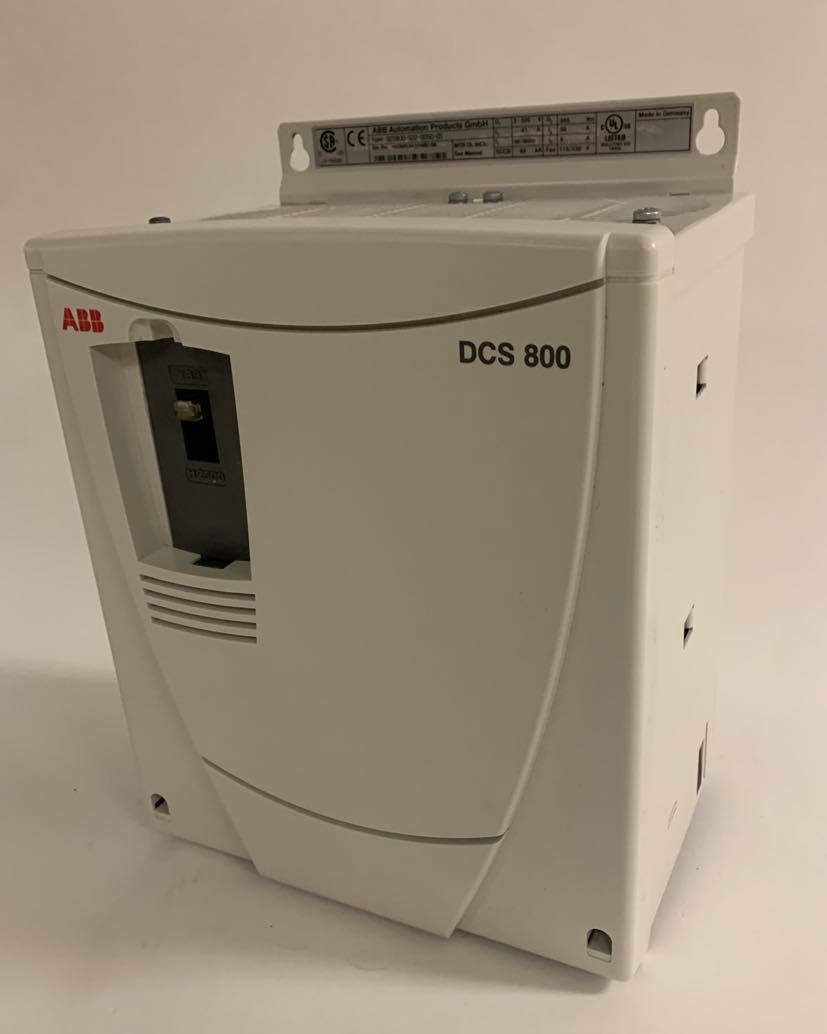
ABB DCS800 DC drive module (unit photographed: DCS800-S02-0050-05; series marking on the cover, rating label on the top bracket)
Key takeaways
- The DCS800 moves from Classic to Limited on 1 January 2027, under ABB's plan published in its ramp-down announcement [1].
- Last order was 31 December 2022 and last delivery 31 March 2023 — no new DCS800 has been orderable for almost four years [1].
- All four variants are affected: S0x modules, A0x cabinets, Exx panel solutions and R0x rebuild and upgrade kits [1].
- In Classic, ABB's wording is “full range of life cycle services and support”, and complete new modules are still available to buy as replacements. In Limited, that becomes a “limited range” [1] — support and spare parts continue on a best-effort basis and are no longer guaranteed [3][4].
- The named latest-generation replacement is the DCS880 [1]. The announcement gives no model-by-model cross, and for larger DCS800 frames ABB also publishes a control-electronics upgrade path, the DCS880-U1 kits [7].
The dates
| Item | Date | Source |
|---|---|---|
| Last order | 31 December 2022 | ABB ramp-down announcement [1] |
| Last delivery | 31 March 2023 | ABB ramp-down announcement [1] |
| Classic → Limited | 1 January 2027 | ABB ramp-down announcement [1] |
One point is worth stating plainly, because it decides how much time is really left: the DCS800's order books closed at the end of 2022. The 2027 date is not an ordering deadline — that passed years ago. It is the date the support promise behind the installed base steps down.
Which DCS800 variants are affected
| Variant | Form | Note |
|---|---|---|
| DCS800-S0x | Converter modules | 20–5200 A DC, frame sizes D1–D7 [2][9] |
| DCS800-A0x | Enclosed converters (cabinets) | Listed as affected in the announcement [1] |
| DCS800-Exx | Panel-mounted solutions | Listed as affected in the announcement [1] |
| DCS800-R0x | Rebuild and upgrade kits | For re-using the power part of larger drives [1] |
How to read a DCS800 type code
| Code position | Meaning | Examples |
|---|---|---|
| S01 / S02 | Bridge type: S01 single bridge (2-Q), S02 anti-parallel (4-Q, for regenerative braking) | S01-0680 = 680 A, 2-Q [2] |
| Current | Rated DC current in amps | 0020–5200 A across D1–D7 [2] |
| Voltage | Rated AC supply code: 04 = 230–400 V, 05 = 230–525 V, 10 = 450–990 V, 12 = 540–1200 V | Full code table in the technical catalogue [2] |
The bridge digit matters more than it looks. A 2-Q spare cannot do the job of a 4-Q regenerative drive, so the full type code — not just the current rating — is what a spare has to match.
What Limited changes — and what it does not
ABB's four-phase model runs Active, Classic, Limited, Obsolete. The ramp-down announcement's own header states the step in one line: Classic carries the “full range of life cycle services and support”, Limited carries a “limited range of life cycle services and support”, and Obsolete leaves “replacement and end-of-life services” [1]. ABB's lifecycle model is built on the obsolescence-management framework of IEC 62402 [5][6], which is why each phase change is announced in advance rather than discovered at the parts counter.
For the DCS800 in Classic today, the announcement is specific: “complete new modules as replacement are available for purchase”, the full range of life cycle services and support is available, and “no actions are required” [1].
What Limited means in ABB's general model wording is also specific, and it is a step down rather than a switch-off. In ABB's words, a product entering Limited “has reached manufacturing end. Technical support and spare parts availability continues on a best-effort basis but is no longer guaranteed” [3]. The same model, stated on ABB's product life cycle management page, says development of the product has come to an end, “spare parts are available as long as components and materials can be obtained”, and towards the end of the Limited phase services gradually become obsolete [4].
What the announcement does not say is equally important, and we will not fill the gaps in:
- It gives no end date for the DCS800's Limited phase and no date for a move to Obsolete.
- It does not publish a per-service table for the DCS800 in Limited — which services narrow, and when, is not itemised.
- It does not state that complete new modules stop being purchasable on 1 January 2027. It confirms they are available in Classic; for service and module availability in Limited, ABB directs readers to its drives services pages and to their local ABB representative [1].
An installed DCS800 does not stop working on 1 January 2027. What changes is the guarantee behind it: guaranteed support ends, and supply of modules and parts moves onto the best-effort, while-materials-last footing that ABB's model describes [3][4]. We saw the same pattern from the other side of the timeline in the ACS310 and ACS355 article — those ranges complete the same journey a step ahead of the DCS800.
Keeping a DCS800 running: spares, upgrade kits, or a DCS880
Three routes exist, and in our judgement they split by frame size and by how critical the driven machine is.
Stock the spare while Classic rules still apply. The one purchase route the announcement guarantees today is the Classic-phase one: complete new modules as replacements [1]. Once Limited starts, module supply sits on the same best-effort footing as everything else [3]. For a critical line — a mill, a hoist, a test stand — whose downtime costs more than a shelf spare, we would treat the remaining Classic window as the time to secure that spare, not the time to start looking.
Upgrade the controls, keep the power section. For the larger frames, ABB publishes DCS880-U1 upgrade kits for existing DC drives including the DCS800: the kits replace the control electronics, while all power components, including the thyristors, are retained. The kit table covers DCS800 frames D5, D6 and D7, and ABB notes that new field exciters might be necessary [7]. That is a narrower intervention than a full drive swap, and it is the only upgrade path ABB documents at this level of detail — it does not cover the smaller frames in the published table.
Replace with the DCS880. The announcement names the DCS880 as the latest-generation product “available for replacement purposes” and tells users to contact their local ABB representative for availability and optional devices [1]. The DCS880 range covers the same 20–5200 A span as the DCS800 [8]. What does not exist — in the announcement or in the DCS880 documents we checked — is an official model-by-model cross from DCS800 to DCS880. Any replacement is therefore a per-installation selection: current, voltage, bridge type and field supply have to be matched individually, and a supplier who quotes a DCS880 against a bare series name, without the full DCS800 type code, is skipping that step.
Before 1 January 2027: the installed-base checklist
Engineers — check:
- The full type designation from the rating plate, including the bridge digit — S01 (2-Q) or S02 (4-Q) decides regenerative capability and which spare actually fits [2].
- Frame size (D1–D7) and rated current per installed unit, so spares and any upgrade kit are matched to the right frame [2]. Our catalogue entry for the DCS800-S01 range is a starting point for the module family.
- The field supply arrangement. Converter modules up to 525 V and 1000 A (frames D1–D4) have built-in field exciters; above that, the field exciter is a separate unit and has to be planned as its own spare or replacement item [2]. This is also the point the DCS880-U1 kit notes flag — a new field exciter might be necessary with an upgrade [7].
- A parameter and firmware backup taken from each installed drive while it is running, plus a note of the control panel fitted — all DCS800 converter modules carry the DCS 800PAN panel [2], and settings do not transfer themselves to a replacement or an upgraded control section.
Procurement and traders — prepare:
- An installed-base list by exact type code, frame and current rating, gathered while Classic-phase module purchase is still the documented route [1].
- For each critical drive, a decision on record: shelf spare, DCS880-U1 control upgrade (D5–D7 frames), or full DCS880 replacement — the three routes have different lead times and different ABB-representative conversations attached [1][7].
- For a replacement selection, the DCS880-S01 family is the current-generation starting point; browse the ABB range on INDPRT or send the installed-base list through our enquiry page. Include a nameplate photo per drive — with bridge type and field supply in play, a partial code is the most common cause of a wrong quote.
FAQ
Can a DCS800 keep running after 1 January 2027? Yes. The phase change governs new purchases, spare-parts supply and service support, not operation. What ends is the guarantee: ABB's model puts Limited-phase support and spare parts on a best-effort basis, available as long as components and materials can be obtained [3][4].
What replaces a DCS800? ABB names the DCS880 as the latest-generation replacement product and directs users to their local ABB representative for availability and optional devices [1]. There is no published model-by-model cross. For frames D5–D7, ABB also offers DCS880-U1 upgrade kits that replace only the control electronics and retain the power section [7].
What should I send with an enquiry for a DCS800 spare? The complete type code from the rating plate (bridge type, current and voltage codes), the frame size, the field supply arrangement, and a nameplate photo. On a DCS800 those details decide both the spare match and whether an upgrade kit or a DCS880 is the realistic route [2][7].
Sources
[1] ABB, Sales Ramp-Down Announcement: DCS800, document 4FPS10000940896 Rev C, 1 November 2021. https://library.e.abb.com/public/b0d4263b5e984b7e9eecbcf6cd566acf/Sales_ramp-down_announcement_DCS800.pdf
[2] ABB, DCS800 Technical Catalogue, document 3ADW000192R0301. (Copy hosted by a third-party site; no direct ABB Library copy of this catalogue revision could be retrieved when this article was prepared.) http://www.melltronics.com/docs/3ADW000192R0301_DCS800_Technical_catalogue_e_c.pdf
[3] ABB, Your product lifecycle (four-phase lifecycle model: Active, Classic, Limited, Obsolete), new.abb.com. https://new.abb.com/pulp-paper/abb-in-pulp-and-paper/articles/your-product-lifecycle
[4] ABB, Product Life Cycle Management, new.abb.com. https://new.abb.com/ev-charging/connected-services/product-life-cycle-management
[5] ABB, Lifecycle Management (LCM), document 9AKK107992A6807 Rev E. https://library.e.abb.com/public/a5cb4cc8b1e443209d6c21a16510bc55/LCM_presentation_ext_9AKK107992A6807_revE.pdf
[6] IEC Technical Committee 56, Dependability standards — listing and abstract of IEC 62402:2019, Obsolescence management. https://tc56.iec.ch/dependability-standards/
[7] ABB, DCS880-U1 Upgrade kits flyer, document 3ADW000726R0201. https://library.e.abb.com/public/bb8daac1b89446abb68bbdbc8d46e349/3ADW000726R0201%20DCS880-U1%20upgrade%20kits%20flyer%20en%20b.pdf
[8] ABB, DCS880 Catalog, document 3ADW000465R0601. https://library.e.abb.com/public/2c0fc39e483b44758da52d37eeaef9b6/3ADW000465R0601%20DCS880%20catalog%20en%20f.pdf
[9] ABB, DCS800 Hardware Manual, document 3ADW000194R0401. https://library.e.abb.com/public/d8b86740eb15d674c1257b0c00545e30/3ADW000194R0401%20DCS800%20Hardware%20Manual%20e%20d.pdf
Need help finding a part?
Send your model and quantity. Our team aims to reply promptly during office hours.