
The ACS800 Is Not One Drive, and It Does Not Have One End Date
| Date | What happens | Which ACS800 types it covers |
|---|---|---|
| 1 January 2025 | Transferred to the Obsolete phase — the product is no longer available | The early units whose rating plate says ACS800 but whose construction is based on ACS600 multidrive hardware (manufactured 2002–2004) [5] |
| Second half of 2028 | New modules stop being available as spare parts during the Classic phase | ACS800-02/-04/-07 R7–R8 [1], ACS800-11/-31 R5–R6 [2], ACS800-17/-37 R6 [3] |
| 1 January 2030 | Transferred from Classic to the Limited phase; spare part modules will not be available in the Limited phase | The same single-drive, regenerative and low-harmonic groups above [1][2][3] |
| End of 2034 | Planned end of the Classic phase — no Limited date announced yet | High-power ACS800-04/-07, 500–2800 kW, frames D4 and R8i [4] |
Ask a plant engineer when the ACS800 ends and you will usually get a shrug, because the honest answer is: which ACS800? ABB's flagship industrial drive family of the 2000s was never a single product. It is wall-mounted single drives, drive modules, cabinet-built drives, regenerative drives, low-harmonic drives and multidrives, spanning 0.55 kW to several megawatts — and ABB manages the life cycle of each group separately, in separate announcements, with separate dates. In July 2025 ABB re-issued several of those announcements at once (revisions dated 1 July 2025), and read together they draw a map that every ACS800 owner should pin above the desk [1][2][3].
A drive that defined a decade of process industry
The ACS800 was ABB's industrial workhorse: a Direct Torque Control (DTC) drive family built for the applications that cannot stop — paper machines, extruders, mixers, cranes, pumps and fans across process industry, marine and metals. The wall-mounted ACS800-01 alone covered 0.55 to 200 kW in frame sizes R2 to R6, in IP21 or IP55 enclosures, with the control panel, line choke, EMC filter and brake chopper options that made it a fit-and-forget unit on thousands of plant walls [6]. Above it sat the ACS800-04 modules and ACS800-07 cabinet drives running into the megawatt range, and beside them the regenerative ACS800-11/-17 and low-harmonic ACS800-31/-37 variants for plants that cared about feeding energy back or keeping harmonics down.
That breadth is exactly why the installed base is still enormous — and why a single headline date for "the ACS800" would be wrong. Some of these drives have been running for more than twenty years. The units manufactured in 2002–2004 on ACS600 multidrive hardware, for example, are already past the end: ABB moved them to the Obsolete phase on 1 January 2025, where, in ABB's own words, "the product is no longer available" [5]. If your rating plate says ACS800 but the drive was built in that window on the older hardware, you are not planning a phase-out — you are already living after it.
What Classic actually means — and why 2028 matters more than 2030
Most of the ACS800 fleet sits in ABB's Classic phase today, but the groups arrived there at different times: the R7–R8 single drives and modules entered Classic on 1 July 2017 [1], the regenerative and low-harmonic R6 drives on 1 April 2019 [3], and the smaller ACS800-11/-31 drives on 1 January 2022 [2]. In the Classic phase ABB still supplies new modules as spare parts and the full range of life cycle services — which is why so many plants have felt no urgency.
The date that should create urgency is not 2030. In all three July 2025 announcements, ABB states that new spare modules remain available only "until the second half of 2028", and that "spare part modules will not be available in the Limited phase" [1][2][3]. Read plainly: from some point in 2028, the factory pipeline of new ACS800 power modules starts to close, a full year and more before the formal Limited date of 1 January 2030. After that, keeping an ACS800 running leans on repair services, remaining stock and the secondary market. Our judgement: for a critical drive, 2028 — not 2030 — is the planning deadline. A spare module on your own shelf, bought while new modules are still orderable, is worth more than a modernization study written in 2029.
The exception proves the rule. The high-power ACS800-04/-07 drives (500–2800 kW, frames D4 and R8i) are planned to stay in Classic until the end of 2034, with spare inverter and supply modules available "until further notice" and, in ABB's words, "no actions are required" [4]. Big drives get a longer runway — which makes sense, because replacing a 2 MW drive is a capital project, not a purchase order.
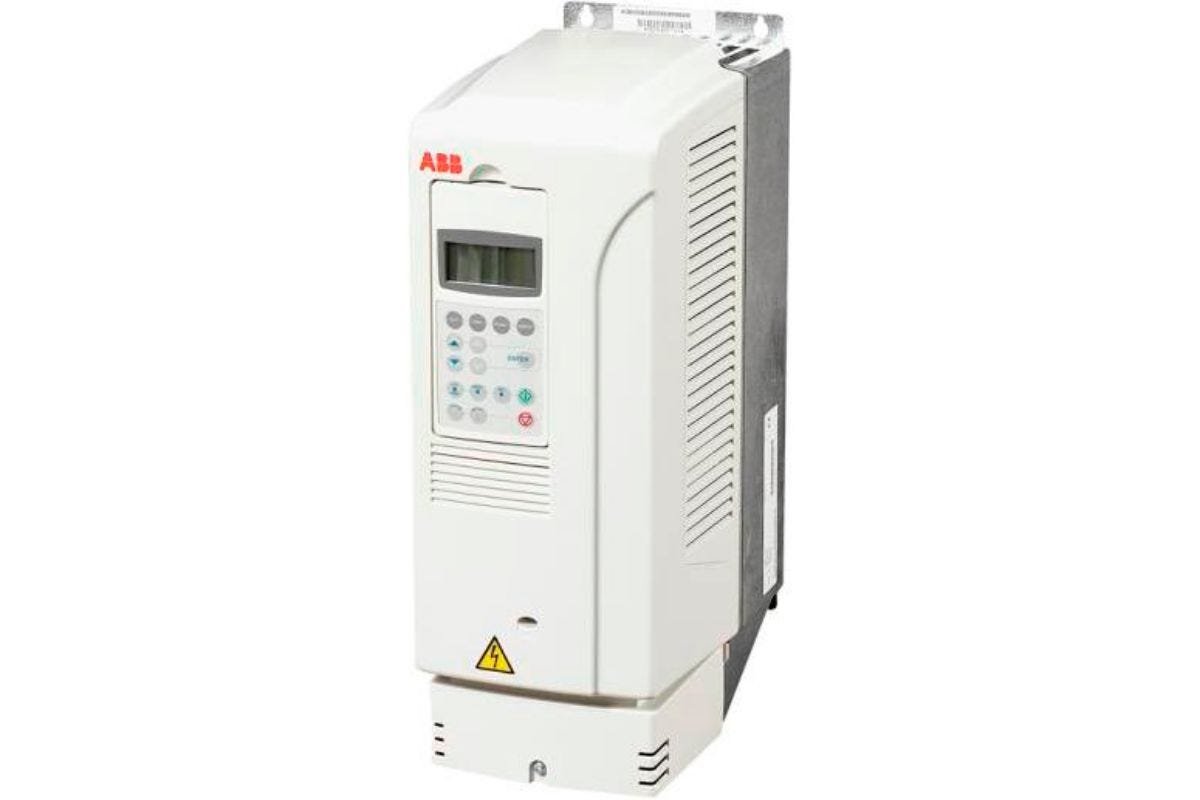
Dealer product photo of an ABB ACS800-01-0016-3 wall-mounted drive (illustrative unit; rating label not legible at this size, not INDPRT stock). The ACS800-01 covered 0.55–200 kW in frames R2–R6 [6].
What one rating plate tells you: ACS800-01 at 400 V
The type designation on the rating plate — family, current code and voltage class — is what ties a drive to its ratings and to its life cycle group. These rows are from ABB's ACS800-01 hardware manual (ratings at a 380/400/415 V supply, 40 °C ambient) [6]:
| Type | Frame | Continuous current Icont.max (A) | Max. current Imax (A) | No-overload power (kW) | Light-overload current I2N (A) / power (kW) | Heavy-duty current I2hd (A) / power (kW) | Heat dissipation (W) |
|---|---|---|---|---|---|---|---|
| ACS800-01-0016-3 | R3 | 25 | 32 | 11 | 24 / 11 | 19 / 7.5 | 340 |
| ACS800-01-0060-3 | R5 | 103 | 138 | 55 | 94 / 45 | 69 / 37 | 1190 |
| ACS800-01-0165-3 | R6 | 260 | 326 | 132 | 254 / 132 | 215 / 110 | 3260 |
| ACS800-01-0205-3 | R6 | 290 | 351 | 160 | 285 / 160 | 234 / 132 | 4200 |
Ratings: ABB ACS800-01/U1 Hardware Manual, 3AFE64382101 [6]. The ACS800-01-0165-3 is a typical mid-range example: a 132 kW wall-mounted unit of exactly the generation now moving through Classic toward the 2028 spare-module horizon.
Three ways forward, in the order we would take them
First, secure the spares while they are still a catalogue item. Until the second half of 2028, new modules for the Classic groups remain available as spare parts [1][2][3]. For a drive whose failure stops a line, holding the power module and control unit for your exact type is the cheapest insurance in this whole story — and after 2028 the same parts come from stockists and surplus channels, at prices set by scarcity. That is the market INDPRT works in: send the full type designation from the rating plate via our ABB brand page or the RFQ page, and we will source against the exact code, not a near match.
Second, look at modernization before full replacement. ABB's own recommended action for the Classic groups is to "modernize or replace the ACS800 product types concerned with a new generation product" [1] — the ACS880 generation. ABB also keeps investing in the installed base in other ways: at ADIPEC 2025 it launched an embedded Electrical Signature Analysis (ESA) service, initially for cabinet-built ACS600 and ACS800 drives, that turns a modernized legacy drive into a condition-monitoring sensor for the whole powertrain — motors, pumps, fans, mixers and conveyors included [7]. In our view this is the most interesting signal in the story: ABB is treating the ACS800 fleet not as scrap-in-waiting but as an asset base worth digitizing. For high-power cabinet drives with years of mechanical life left, a modernization that keeps the cabinet and adds monitoring can be a better spend than a rip-and-replace.
Third, plan the ACS880 migration for the drives that earn it. Where a drive is heavily loaded, application-critical and already short of spares cover, moving to the current generation on a planned shutdown beats doing it on a failure. We covered the first ABB families entering this end-of-life pattern in our notes on the ACS310 and ACS355 moving to Obsolete and the DCS800 moving to Limited — the ACS800 is the same story at a much larger scale, just with a longer, better-signposted runway.
Our bottom line: the ACS800 does not end on a date. It ends group by group — one subgroup already Obsolete since 2025, most of the fleet losing new spare modules in the second half of 2028 and entering Limited in 2030, and the high-power drives running in Classic to the end of 2034. The plants that come out of this best will be the ones that read their own rating plates in 2026, not the ones that read ABB's announcements in 2029.
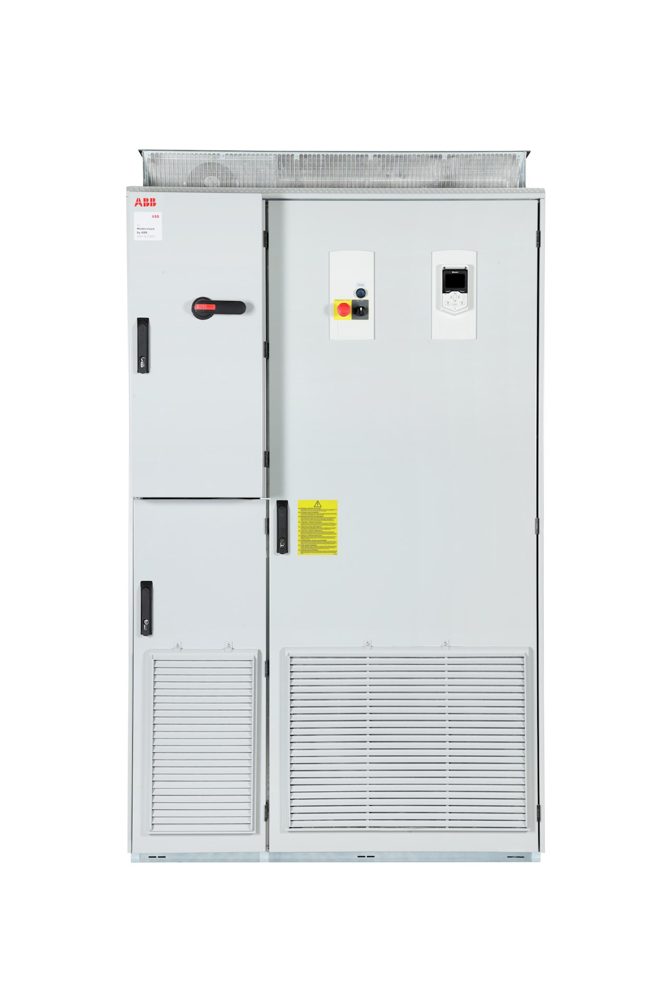
ABB press photo: a modernized ACS800 high-power single drive with integrated ESA (Electrical Signature Analysis) capabilities, from ABB's ADIPEC 2025 launch [7].
Sources
[1] ABB, Product Life Cycle Announcement: ACS800 Single Drives and Drive Modules, ACS800-02/-U2/-04/-U4/-04(M)/-07/-U7 (R7–R8), document 4FPS10000572196 Rev E, 1 July 2025. https://library.e.abb.com/public/e2c62f961c5247ce85494394db0861d2/Life%20cycle%20announcement%20ACS800%20SD%20R7-R8%20rev%20E.pdf [2] ABB, Product Life Cycle Announcement: ACS800 Regenerative and Low Harmonic Drives, ACS800-11/-U11/-31/-U31, document 4FPS10000625377 Rev H, 1 July 2025. https://library.e.abb.com/public/eb5d53a06f9649469594c41990fa37d1/LC%20Announcement%20ACS800-11%20-31%20revH.pdf [3] ABB, Product Life Cycle Announcement: ACS800 Regenerative and Low Harmonic Drives, air-cooled, ACS800-17/-37 (R6), document 4FPS10000619930 Rev F, 1 July 2025. https://library.e.abb.com/public/e4986e6410464172b27e9c6b11f2cb5b/LC%20Announcement%20ACS800-17%20-37%20R6%20rev%20F.pdf [4] ABB, Product Life Cycle Statement: ACS800 Single Drives and Drive Modules, ACS800-04/-07 (500–2800 kW, D4/R8i), document 4FPS10000572197 Rev D, 1 July 2021. https://library.e.abb.com/public/6f24e8144dbf4031a1dc9e7bd0b917c7/Life-cycle-statement_ACS800_SD_D4_R8i_rev_D.pdf [5] ABB, Product Life Cycle Announcement: Product type ACS800 based on ACS600 multidrive hardware, document 4FPS10000657232 Rev D, 1 July 2024. https://library.e.abb.com/public/67e52af50e7340e3827ed27cfd164890/LC_Announcement_ACS800_based_on_ACS600_HW_revD.pdf [6] ABB, ACS800-01/U1 Drives Hardware Manual (0.55 to 200 kW), 3AFE64382101 Rev L, effective 2023-12-01. https://library.e.abb.com/public/6a950a45663b4c408cbc55c72212ce15/EN_%20ACS800_01_HW_L_A4.pdf [7] ABB, "ABB launches embedded ESA technology in drives, turning modernization into a digital catalyst", ABB news release, ADIPEC 2025. https://new.abb.com/news/detail/130546/abb-launches-embedded-esa-technology-in-drives-turning-modernization-into-a-digital-catalyst
Need help finding a part?
Send your model and quantity. Our team aims to reply promptly during office hours.